 The 1954 battlefield, mountain roads and villages of Dien Bien, explained in English

History · Sites
The 1954 battlefield sites, one by one
What each preserved site in the Dien Bien Phu valley is, what you will see there, how long it takes, and the opening hours and fees that apply in 2026. Written for visitors who know the battle only by name.
Opening hours and fees in 2026
| Period | Morning | Afternoon |
|---|---|---|
| 1 March – 30 September | 07:00–11:00 | 13:30–18:00 |
| 1 October – end of February | 07:00–11:00 | 13:30–17:30 |
These hours were set by the Dien Bien Provincial Relics Management Board from March 2026 for the sites of the special national relic and apply every day, including public holidays and Tet. On a few occasions A1 Hill, the Victory Monument on Hill D1 and the Martyrs' Temple on Hill F have also opened in the evening, 19:30–22:00, for specific events; do not plan on it.
| Site | Adult fee | Note |
|---|---|---|
| Victory Museum | 100,000 VND | Since 1 August 2022; half price aged 60+ and for people with disabilities; free under 18 |
| A1 Hill | About 20,000 VND, reported | Independent guide, 2025; confirm at the gate |
| De Castries bunker, Him Lam and other hills | Small fee, similar range | No current official figure found |
| Cemeteries and monuments | Usually free to enter | Dress and behave as at any cemetery |
Ethnic residents of the province have been given free entry on some holidays, and anniversaries can bring special arrangements. Fees are paid in cash, in dong.
Sources: Bao Van Hoa — Dien Bien Relics Management Board changes opening hours (March 2026); Bao Van Hoa — evening opening at A1, D1 and Hill F (October 2025); Bao Van Hoa — Victory Museum fee under Resolution 03/2022/NQ-HDND; Local Vietnam — A1 Hill (independent guide); Bao Van Hoa — holiday free entry for Dien Bien residents (2024) · last checked .
How the valley was laid out in 1954
The French Union garrison held a camp on the valley floor, built around an airstrip, with strongpoints on the small hills around it. Each strongpoint had a woman's name. The Vietnamese names used on the ground today are different, which confuses many visitors, so here is the key for the main ones:
| French name | Vietnamese name today | What happened |
|---|---|---|
| Béatrice | Him Lam hill | North-east outpost, attacked on the first evening, 13 March 1954, and lost that night |
| Gabrielle | Doc Lap hill | Northern outpost, attacked on the night of 14 March and lost the next morning |
| Dominique | D hills, including D1 | East-central hills; Dominique 1 and 2 fell on 30 March. The Victory Monument now stands on D1 |
| Éliane 2 | A1 Hill | Key eastern hill, fought over from 30 March until it was mined and taken on 6–7 May |
| Isabelle | Hong Cum | Southern position about 6 km away, covering a reserve airstrip |
The camp's command post, the bunker of Colonel (later General) Christian de Castries, stood in the centre near the Nam Rom river. The Vietnamese command was in the forest at Muong Phang, in the hills to the east.
Sources: French Ministry of the Armed Forces, Chemins de memoire — Battle of Dien Bien Phu; Wikipedia — Battle of Dien Bien Phu (casualty figures from several sides); Bac Ninh newspaper — 14 March 1954, attack on Doc Lap hill; VTV — Hill A1, where blood once stained the trenches; Lowy Institute, The Interpreter — Dien Bien Phu: digging into history · last checked .
A1 Hill
A1 is the most visited site and the one to see if you see only one. It was the hill the French called Éliane 2, the strongest of the eastern positions, and the fighting for it lasted more than five weeks. Vietnamese troops attacked from the night of 30 March to 1 April and took half of the hill; the two sides then held trenches a few metres apart. Vietnamese engineers dug a tunnel under the French position and packed it with explosives, about 960 kg to 1,000 kg depending on the source, which was detonated at 20:30 on 6 May. A1 was fully taken at 04:00 on 7 May, hours before the end of the battle.
Today you walk a path through restored trenches to the summit, where the crater of the mine is still visible, along with a French tank, the remains of a concrete bunker and the stump of a banyan tree used as a blockhouse. A sign at the top reads "A1 – Mud, blood and flowers". Two poinciana trees on the summit flower red from late April into May. Allow 45 minutes to an hour. The A1 military cemetery is across the road.
Sources: VTV — Hill A1, where blood once stained the trenches; Local Vietnam — A1 Hill (independent guide); Lowy Institute, The Interpreter — Dien Bien Phu: digging into history · last checked .
The Victory Museum
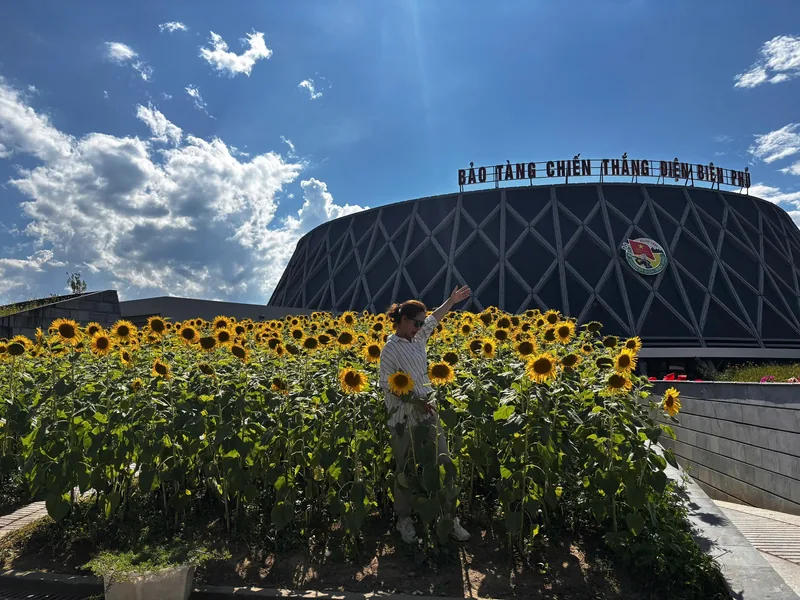
The museum opened on 5 May 2014, replacing an older one founded in 1984. The building is a low, rounded cone patterned like a camouflage net, a reference to the hats worn by Vietnamese soldiers. Inside are over 1,000 artefacts, documents and photographs arranged in sequence: the background to the campaign, the supply effort, the three phases of the battle and its aftermath. Exhibits include artillery pieces and personal objects, such as a bicycle of the kind used to carry supplies over mountain tracks.
The upper floor holds a 360-degree panorama painting, 132 m long and 20.5 m high, depicting the battle with around 4,500 figures. You remove your shoes to enter it. Labels are in Vietnamese, English and French, though the English is uneven. Allow 45 minutes for a quick look and up to two hours if you read everything. The museum faces A1 Hill on Vo Nguyen Giap Street, and it is a good first stop because it gives you the overall picture.
Sources: Wikipedia — Dien Bien Phu Victory Museum; Government news portal — Victory Museum opens (2014); Local Vietnam — Victory Museum visitor guide (independent guide); Vietnam Law Magazine — Dien Bien Phu battlefield relics complex · last checked .
The de Castries command bunker
About 700 m east of A1, across the river, is the reconstructed command bunker of the French camp. It is a long, low structure of steel and sandbags, partly underground, fenced and surrounded by guns and tanks. It was here, on 7 May 1954, that the garrison command was captured and the battle ended.
The bunker is a reconstruction rather than an original structure, and it is small: a visit takes 20 to 30 minutes. It is busy with Vietnamese visitors at weekends and in early May. For French visitors it can be a difficult place; it is where the defence of the camp ended.
Sources: Vietnam Law Magazine — Dien Bien Phu battlefield relics complex; Lowy Institute, The Interpreter — Dien Bien Phu: digging into history · last checked .
The Victory Monument on Hill D1
The bronze monument on Hill D1 was completed in April 2004 for the 50th anniversary of the battle. It shows three Vietnamese soldiers standing on the roof of the de Castries bunker, one carrying a rifle, one a flag and one holding a child with a bunch of flowers. The statue is 12.6 m high on a 3.6 m pedestal. A long stepped path leads up from the road, counted at 320 steps in one official account, and a 58 m stone relief was added in a second stage completed in 2009.
The climb is steep in the heat; go early or late in the day. The reward is the clearest view over the valley and the town, which helps you see how the camp sat in the basin with hills on every side.
Sources: Vietnam National Authority of Tourism — Statue of Dien Bien Phu Victory; People's Army newspaper — Victory Monument · last checked .
Him Lam and Doc Lap hills
Him Lam, the French Béatrice, was the first position attacked, on the evening of 13 March 1954, and it fell that night. Doc Lap, the French Gabrielle, to the north, was attacked the next night and lost on 15 March. Both have restored trenches and bunkers and see far fewer visitors than A1. They are worth a stop if you want to understand how quickly the northern defences collapsed in the first days.
Him Lam and Doc Lap each have a Vietnamese military cemetery nearby. Parts of these outlying positions have been eroded or built over, so expect less to see than at A1.
Sources: Bac Ninh newspaper — 14 March 1954, attack on Doc Lap hill; Wikipedia — Battle of Dien Bien Phu (casualty figures from several sides); VTV — Hill A1, where blood once stained the trenches; Lowy Institute, The Interpreter — Dien Bien Phu: digging into history · last checked .
Cemeteries and memorials
The A1 National Martyrs' Cemetery, built in 1958, holds the graves of Vietnamese soldiers killed in the campaign, in rows of identical headstones; many are unnamed. The Him Lam and Doc Lap cemeteries are smaller. The Martyrs' Temple on Hill F is a memorial temple where Vietnamese visitors offer incense.
The French dead have no cemetery in the valley. A memorial to them was erected in 1994 on the initiative of Rolf Rodel, a former Foreign Legion non-commissioned officer, and officially unveiled in 1999. France has no legal rights over it; it is maintained under an agreement with the provincial authorities and funded by the French Ministry of the Armed Forces. It stands separately from the Vietnamese cemeteries. In November 2018 the French prime minister laid a wreath there.
At all of these places, dress modestly, keep your voice down and ask before photographing people paying their respects.
Sources: Vietnam Law Magazine — Dien Bien Phu battlefield relics complex; VTV — Hill A1, where blood once stained the trenches; French Ministry of the Armed Forces, Chemins de memoire — the Dien Bien Phu memorial; vietnamtourism.com — Dien Bien Phu, the battle and how to visit (independent guide) · last checked .
A visiting order that works
- 01
Start at the Victory Museum
Open at 07:00. The panorama and displays give you the shape of the battle.
- 02
Cross to A1 Hill and the A1 cemetery
Walk across the road; finish before the 11:00 closure.
- 03
Afternoon: de Castries bunker
From 13:30, by taxi or motorbike across the river.
- 04
End at the Victory Monument on D1
Climb late in the afternoon for the view over the valley.
That covers the core sites in a day. Him Lam, Doc Lap, the French memorial and Muong Phang fit into a second day. See how many days for full plans.
Sources: Bao Van Hoa — Dien Bien Relics Management Board changes opening hours (March 2026) · last checked .
Who will find these sites hard going
- Visitors who want a balanced historical exhibition. The sites present the Vietnamese view of a national victory; the French experience is barely represented apart from the memorial.
- Anyone with limited mobility, at A1 and the Victory Monument, which involve steep paths and steps.
- Visitors in the middle of the day in April and May, when the heat on the exposed hills is heavy.
- Travellers who arrive at 10:45 or 17:00. The lunch closure and evening closing are strictly kept.
Common questions
Questions readers ask
What are the opening hours of the Dien Bien Phu sites?
From March 2026: 07:00–11:00 and 13:30–18:00 from 1 March to 30 September, and 07:00–11:00 and 13:30–17:30 from 1 October to the end of February, every day.
How much is the Victory Museum ticket?
100,000 VND per adult since August 2022, half price for people aged 60 or over, and free for under-18s.
Is the de Castries bunker original?
It is a reconstruction on the original site of the French command post.
Is there a French cemetery at Dien Bien Phu?
No. There is a memorial to the French dead, erected in 1994 and unveiled in 1999, maintained with French funding under an agreement with the province.
Related
Read next
History · Background
The 1954 battle
The battle in brief: background, the 56 days, losses on both sides, and how it is remembered.
Read more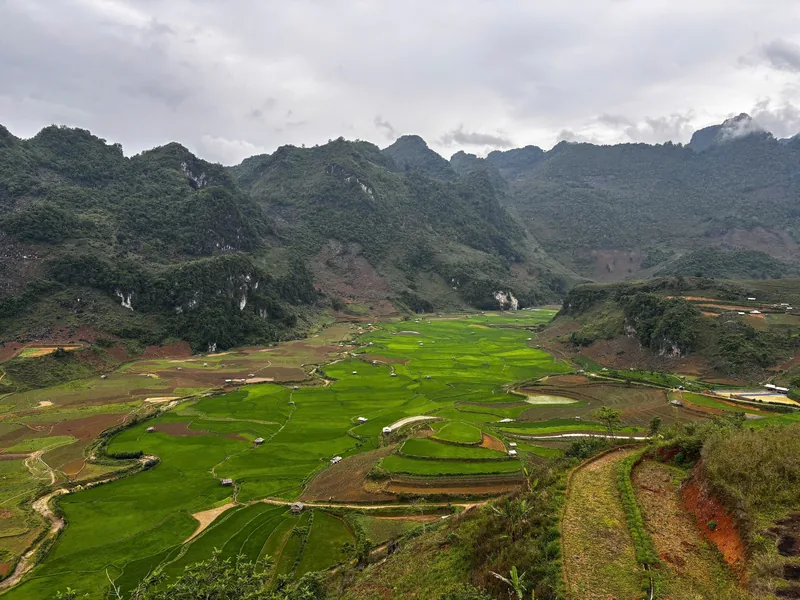
Places · Dien Bien Phu
Dien Bien Phu
The town and valley at the centre of the province: sites, nights, seasons, transport and costs.
Read more
Places · Muong Phang
Muong Phang
The command headquarters in the hills east of Dien Bien Phu, with the nearby village and lake.
Read more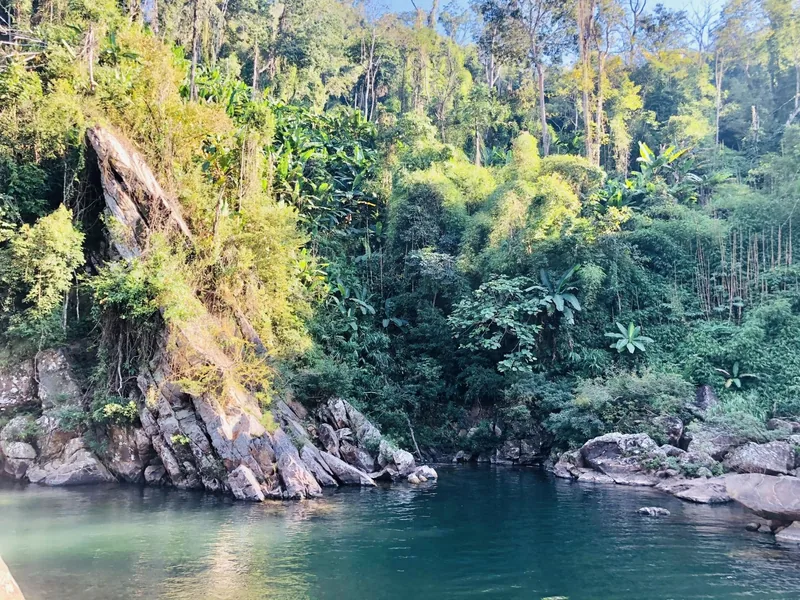
Planning · Days
How many days
Sample plans for one to five days in Dien Bien, and how arrival, opening hours and seasons change them.
Read more
Planning · Seasons
When to go
Dien Bien month by month: dry and wet seasons, ban flowers in March, rice harvests and anniversary dates.
Read more
Planning · Getting there
Getting there
Flights, sleeper buses and riding to Dien Bien Phu compared, with times, fares and the rules for motorbikes.
Read more
Start planning
Send a correction or a question
Tell us which page you are writing about, what you found and when. A link to an official notice or a photo of a sign helps us check it.